
Insulation Materials & Types in Los Angeles, CA
Energy-Saving Insulation Materials & Types in Los Angeles for Los Angeles, CA Homes — Licensed & Insured
Learn which insulation materials work best for Los Angeles homes. Compare R-values, costs, and pros/cons of spray foam, batts, blown-in & more.
- Licensed & Insured
- Locally Owned & Operated
- Free Inspection & Estimate
Request Your
Free EstimateChoosing the right insulation material for your Los Angeles home is more nuanced than simply picking the cheapest option. Los Angeles’s climate presents a unique combination of challenges: scorching summer temperatures that regularly push attic spaces past 150°F, mild but occasionally damp coastal air in neighborhoods like Santa Monica and Torrance, low relative humidity inland, and an ever-present wildfire risk in hillside communities from the Hollywood Hills to the San Fernando Valley.
At the center of every insulation decision is R-value — a measurement of thermal resistance. The higher the R-value, the better a material resists heat transfer. In Los Angeles (primarily Climate Zone 9 and portions of Zone 10), the right R-value keeps summer heat out of living spaces and reduces the strain on air conditioning systems, which directly impacts monthly energy bills.
This guide covers every major insulation material available to Los Angeles homeowners — what each one is, how it performs in Southern California’s specific conditions, where it works best in your home, and what it typically costs to install.
Understanding Insulation Types for Los Angeles Homes
Insulation materials fall into several broad categories, each with distinct physical properties, installation methods, and performance characteristics. For Los Angeles homeowners, no single material is universally best — the right choice depends on where in your home you’re insulating, your home’s age and construction type, your proximity to the coast or wildfire-prone areas, and your budget.
Los Angeles’s housing stock is remarkably diverse. Craftsman bungalows built in the 1920s in Highland Park often have little to no wall insulation and outdated attic coverage. Mid-century modern homes in the Westside may have open-beam ceilings requiring special approaches. Newer construction in Valencia or Irvine-adjacent developments must comply with California’s Title 24 energy code, which sets minimum R-value requirements by climate zone.
California’s Title 24 Part 6 energy standards are among the strictest in the nation. For Climate Zone 9, the code typically requires attic insulation of R-38 minimum and wall insulation of R-13 to R-21 depending on framing and assembly type. However, meeting code minimums does not always mean achieving maximum energy efficiency for Southern California’s conditions.
The six primary insulation material categories available in Los Angeles are spray foam, blown-in loose-fill, fiberglass batt, mineral wool, cellulose, and rigid foam board. Understanding each one — and how Los Angeles’s climate affects its performance — helps homeowners make informed, lasting decisions.
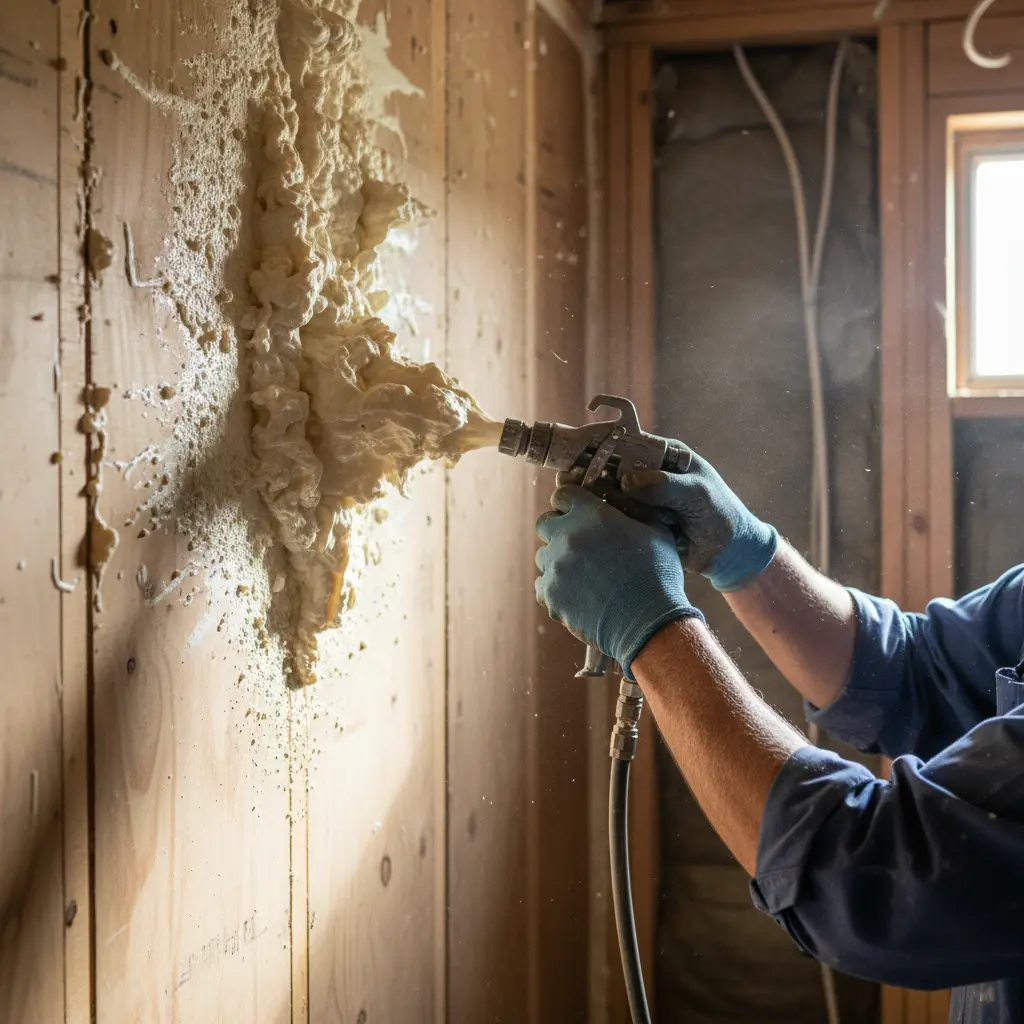
Our team in action — insulation professionals serving Los Angeles
How Los Angeles’s Climate Affects Your Insulation Material Choice
Los Angeles sits primarily in IECC Climate Zone 3 and California Title 24 Climate Zones 9 and 10, characterized by hot, dry summers and mild winters. But within Los Angeles County, microclimates vary dramatically. Understanding your specific conditions is essential to choosing the right material.
Summer heat and attic temperatures: Attic spaces in the San Fernando Valley, East Los Angeles, and the South Bay regularly reach 140°F to 160°F in summer. High-R-value materials that also air-seal — particularly closed-cell spray foam applied to the roof deck — are most effective at stopping radiant and convective heat from entering living spaces.
Coastal proximity and humidity: Within a few miles of the Pacific in areas like Venice, Culver City, and Long Beach, marine layer moisture can penetrate poorly protected wall cavities. Closed-cell spray foam and moisture-resistant mineral wool are preferable to paper-faced fiberglass in these zones.
Wildfire risk zones: Properties in Very High Fire Hazard Severity Zones (VHFHSZ) — which cover significant portions of the Hollywood Hills, Topanga, and Sylmar — benefit from non-combustible mineral wool or fiberglass batts in wall assemblies, rather than foam-based products where flame spread ratings are a concern.
New construction vs. retrofit: New builds can incorporate continuous rigid foam or spray foam during framing. Existing homes typically require blown-in or drill-and-fill methods for walls, and blown-in or batt additions for attics. Matching the installation method to your home’s construction type prevents costly mistakes.
Insulation Materials Available in Los Angeles, CA
Spray Foam Insulation
Spray polyurethane foam (SPF) comes in two forms: open-cell (R-3.5 to R-4 per inch) and closed-cell (R-6 to R-7 per inch). Closed-cell spray foam is particularly well-suited to Los Angeles because it creates an air and moisture barrier simultaneously, resisting the coastal humidity that can degrade other materials over time. Open-cell foam is better for interior wall cavities where vapor diffusion is less of a concern. Both types seal gaps and penetrations that allow hot outside air to infiltrate. Best applications include attic roof decks, rim joists, crawl spaces, and older walls with irregular framing. The primary drawback is cost — spray foam typically runs $1.50 to $4.50 per square foot installed, making it the most expensive option. However, energy savings in high-AC-use Los Angeles homes often produce a favorable payback period.
Blown-In (Loose-Fill) Insulation
Blown-in insulation — typically fiberglass or cellulose loose-fill — is installed using a machine that blows material into attic floors or enclosed wall cavities. R-values range from R-2.2 to R-3.8 per inch depending on material. For Los Angeles attics, blown-in insulation is one of the most cost-effective ways to reach or exceed Title 24’s R-38 requirement. It conforms to irregular joist spacing common in older Los Angeles homes and covers obstructions that batts cannot. The main limitation is settling over time, which can reduce effective R-value. Coastal homeowners should ensure proper attic ventilation to prevent moisture accumulation. Installed costs typically run $0.80 to $2.00 per square foot. Best applications: attic floors, existing closed wall cavities via drill-and-fill.
Fiberglass Batt Insulation
Fiberglass batts are the most familiar insulation product — pre-cut panels of spun glass fiber that fit between standard wall studs and ceiling joists. R-values range from R-11 to R-38 depending on thickness. In Los Angeles, fiberglass batts are a dependable, budget-friendly choice for new construction or open wall renovations where stud bays are fully accessible. However, they must be installed without gaps, voids, or compression to achieve rated performance — a common issue in DIY or rushed installations. In coastal zones, unfaced batts can absorb moisture if vapor management is not addressed. Fiberglass batts are non-combustible, a meaningful advantage in wildfire-adjacent communities. Installed cost runs approximately $0.50 to $1.50 per square foot. Best applications: open wall cavities, attic floors, floors over unconditioned spaces.
Mineral Wool / Rockwool Insulation
Mineral wool (also marketed as Rockwool or stone wool) is made from volcanic rock and recycled steel slag. It offers R-3.0 to R-4.2 per inch and is naturally fire-resistant up to approximately 1,800°F — making it a compelling choice for Los Angeles homeowners in wildfire risk zones in communities like Malibu, Altadena, or the Santa Monica Mountains. Mineral wool also resists moisture absorption and provides superior sound attenuation, valuable in dense urban neighborhoods. It is denser than fiberglass, which reduces air movement through the batt cavity. The main drawback is cost — roughly $1.00 to $2.50 per square foot installed, somewhat higher than standard fiberglass. Best applications: exterior walls, attic floors, areas where fire resistance and soundproofing are priorities.
Cellulose Insulation
Cellulose is made from recycled paper fiber treated with borate-based fire retardants. It offers R-3.2 to R-3.8 per inch and is one of the most environmentally sustainable insulation options. In Los Angeles, cellulose performs well in attic applications and is an excellent retrofit choice for older homes with no existing insulation. Borate treatment also provides resistance to pests — relevant in areas where rodents access attics through mature landscaping. The key concern in coastal or high-humidity microclimates is moisture management; wet cellulose loses R-value and can harbor mold if ventilation is inadequate. Installed cost typically ranges from $0.75 to $1.75 per square foot. Best applications: attic floors, dense-packed wall cavities in existing homes, environmentally focused projects.
Foam Board (Rigid) Insulation
Rigid foam board insulation includes expanded polystyrene (EPS) at R-3.8/inch, extruded polystyrene (XPS) at R-5/inch, and polyisocyanurate (polyiso) at R-6 to R-6.5/inch. These panels are used where thicker batts or blown-in insulation are impractical — exterior walls, under slabs, and in low-clearance spaces. In Los Angeles, rigid polyiso is popular for continuous exterior insulation on remodels and additions, helping meet Title 24 wall assembly requirements without consuming interior space. Foam board is lightweight and easy to cut, but requires a fire-rated thermal barrier (typically drywall) when used on interior surfaces. Installed costs range from $1.00 to $3.50 per square foot depending on thickness and type. Best applications: exterior sheathing, basement or crawl space walls, under concrete slabs.
Ready for Insulation Materials & Types? Get Your Free Estimate Today.
Air Tight Insulation serves Los Angeles and the surrounding area — we’ll be on-site within 24 hours.
📞 Call 323-618-6376Why Los Angeles Homeowners Trust Air Tight Insulation for Insulation
Air Tight Insulation has served the Los Angeles area with honest, expert insulation guidance across every property type — from 1930s Craftsman bungalows to modern hillside retreats. Here is why local homeowners choose us:
Insulation Materials FAQ for Los Angeles Homeowners
What is the best insulation type for Los Angeles’s climate?
There is no single best material — it depends on where you are insulating and your home’s specific conditions. For attics in hot inland areas, blown-in insulation or closed-cell spray foam applied to the roof deck delivers strong performance. For coastal homes where moisture management matters, closed-cell spray foam or mineral wool is preferable. For wildfire-adjacent properties, non-combustible mineral wool or fiberglass provides an added safety margin. A professional assessment identifies the right material for each area of your home.
What R-value does Los Angeles require for attics and walls?
Under California’s Title 24 energy code, Climate Zone 9 homes (which covers most of Los Angeles) require a minimum of R-38 in attic assemblies and R-13 to R-21 in wall assemblies depending on framing type and construction. Climate Zone 10, which covers hotter inland areas like parts of the San Fernando Valley, may require R-30 to R-38 in ceilings and additional wall insulation. Many energy professionals recommend exceeding minimums — particularly R-49 or higher in attics — to achieve meaningful reductions in cooling costs during Southern California summers.
How do insulation material costs compare in Los Angeles?
Installed costs vary by material and application. Fiberglass batts are the most affordable at roughly $0.50 to $1.50 per square foot. Blown-in cellulose or fiberglass runs $0.75 to $2.00 per square foot. Mineral wool batts typically cost $1.00 to $2.50 per square foot installed. Rigid foam board ranges from $1.00 to $3.50 per square foot. Spray foam — particularly closed-cell — is the most expensive at $1.50 to $4.50 per square foot but often delivers the highest energy performance and air-sealing value. Total project cost also depends on attic or wall square footage, accessibility, and existing insulation removal if needed.
Is attic insulation or wall insulation more important in Los Angeles?
Attic insulation generally delivers the highest return on investment in Los Angeles because heat gain through the roof is the dominant energy load in Southern California’s climate. An under-insulated attic can make your home feel like an oven and drive air conditioning costs significantly higher. Wall insulation is still important — particularly for reducing radiant heat through west- and south-facing walls — but for most existing homes, upgrading attic insulation to R-38 or above should be the first priority. New construction or major remodels should address both simultaneously.
How much energy can improved insulation save in a Los Angeles home?
According to the U.S. Department of Energy, properly air-sealing and insulating an existing home can reduce heating and cooling costs by 10 to 20 percent annually. In Los Angeles, where air conditioning runs for six to eight months a year in many neighborhoods, savings toward the higher end of that range are realistic. Homes with little to no existing insulation — common in pre-1970s construction in neighborhoods like Echo Park, Boyle Heights, and the San Gabriel Valley — can see even more dramatic reductions. Specific savings depend on home size, current insulation levels, and the materials selected.
Are there rebates or tax credits available for insulation in California?
Yes. Los Angeles homeowners have access to several incentive programs. The Los Angeles Department of Water and Power (LADWP) and SoCalGas both offer rebates for qualifying insulation upgrades in existing homes. The federal Inflation Reduction Act provides a tax credit of up to 30 percent of insulation project costs (up to $1,200 per year) for homeowners who improve their home’s energy efficiency. California’s Energy Upgrade California program also connects homeowners with additional rebates. Eligibility requirements and rebate amounts change periodically, so it is advisable to verify current offerings before beginning a project.
How do I know if my existing insulation needs to be replaced or just added to?
In many cases, existing insulation can be supplemented rather than removed — adding blown-in material over old fiberglass batts in an attic is a common and cost-effective approach. However, insulation that has been damaged by moisture, pest intrusion, or fire smoke should be removed before new material is installed. A professional assessment measures current R-values, checks for air gaps and bypasses, inspects for moisture damage, and determines whether topping up or full replacement is the right approach for your home.
Does insulation help with soundproofing in Los Angeles?
Yes, particularly in densely populated neighborhoods or homes near freeways and airports. Mineral wool (Rockwool) provides the highest sound attenuation among common insulation materials, followed by dense-pack cellulose and open-cell spray foam. Standard fiberglass batts offer modest sound reduction. If acoustic performance is a priority — for example, in Silver Lake, Koreatown, or near LAX flight paths — mineral wool in interior walls and ceilings delivers the best combination of thermal and acoustic performance.
Get a Free Insulation Assessment in Los Angeles
Not sure which insulation material is right for your home? Air Tight Insulation offers a free, no-obligation insulation assessment for Los Angeles homeowners. Our experienced team will evaluate your attic, walls, and crawl spaces, measure existing R-values, identify air leakage points, and recommend the materials and approach that best fit your home’s construction, your local climate conditions, and your budget.
We are fully licensed and insured, and we are familiar with LADWP and SoCalGas rebate programs that may help offset project costs. Whether you are dealing with a sweltering attic in Reseda or managing coastal moisture in Playa del Rey, we will help you find the right solution.
Call us today at 323-618-6376 to schedule your free assessment and start making your Los Angeles home more comfortable and energy-efficient year-round.