
Blown-In Insulation in Los Angeles, CA
Energy-Saving Blown-In Insulation in Los Angeles, CA for Los Angeles, CA Homes — Licensed & Insured
Air Tight Insulation provides expert blown-in insulation in Los Angeles, CA. Free estimates, Title 24 compliance & LADWP rebate help. Call 323-618-6376 today.
- Licensed & Insured
- Locally Owned & Operated
- Free Inspection & Estimate
Request Your
Free EstimateBlown-in insulation is a high-performance insulation method that uses loose-fill material — typically cellulose or fiberglass — pneumatically blown into attic cavities, wall voids, and crawl spaces to create a seamless thermal barrier. Unlike traditional batt insulation, blown-in insulation conforms to irregular surfaces, fills gaps around obstructions, and achieves consistent coverage throughout the entire installation area.
In Los Angeles, CA, where temperatures can swing from the mid-40s°F on winter nights in the San Fernando Valley to over 100°F during summer heat events, maintaining an efficiently insulated home is not a luxury — it is a necessity. The region’s unique combination of Mediterranean climate, wildfire smoke infiltration, and aging housing stock creates specific insulation demands that generic solutions fail to address.
At Air Tight Insulation, we specialize in blown-in insulation solutions tailored specifically to Los Angeles homes and buildings. Our team understands local building codes, climate conditions, and construction styles — from mid-century bungalows in Silver Lake to post-war tract homes in the West Valley. Call us today at 323-618-6376 to schedule your assessment.
Understanding Blown-In Insulation
Blown-in insulation, also known as loose-fill insulation, has been used in residential and commercial construction since the early twentieth century. The method gained widespread adoption in the 1970s following the oil embargo and the national push for energy efficiency. By the 1980s and 1990s, blown-in cellulose and fiberglass had become standard retrofit solutions for existing homes that lacked adequate insulation in their attic assemblies.
The process works by feeding loose insulation material into a hopper-equipped blowing machine, which uses air pressure to convey the material through a flexible hose. A trained technician directs the hose across the attic floor or wall cavity, depositing the material at a controlled depth and density. The result is a uniform insulation layer that fills every corner, bypasses pipes and wiring, and covers the entire conditioned area without leaving cold spots or thermal bridges.
Two primary materials dominate the blown-in market. Cellulose is manufactured from recycled paper products treated with borate-based fire retardant and pest-resistant compounds. It achieves an R-value of approximately R-3.2 to R-3.8 per inch and is favored for its sustainability profile and dense-pack wall applications. Blown-in fiberglass, made from spun glass fibers, offers an R-value of R-2.2 to R-2.7 per inch in open-blow applications and is highly resistant to moisture absorption, making it particularly relevant in coastal areas of Los Angeles like Venice, Santa Monica, and El Segundo.
Los Angeles’s housing stock is notably diverse. The city contains millions of single-family homes built between 1920 and 1980, many of which were constructed with little to no attic insulation by today’s standards. The California Department of Energy estimates that homes built before 1978 in the Los Angeles basin commonly have attic insulation levels between R-7 and R-11 — far below the current Title 24 requirement of R-38 for attics in Climate Zone 9, which covers most of the Los Angeles metro area. Blown-in insulation is among the most cost-effective and minimally invasive methods to bring these older homes up to modern energy performance standards.
Beyond residential applications, blown-in insulation is widely used in Los Angeles’s multi-family housing market, commercial low-rise buildings, and the region’s growing stock of accessory dwelling units (ADUs), which are frequently converted garages or detached structures with minimal existing insulation.
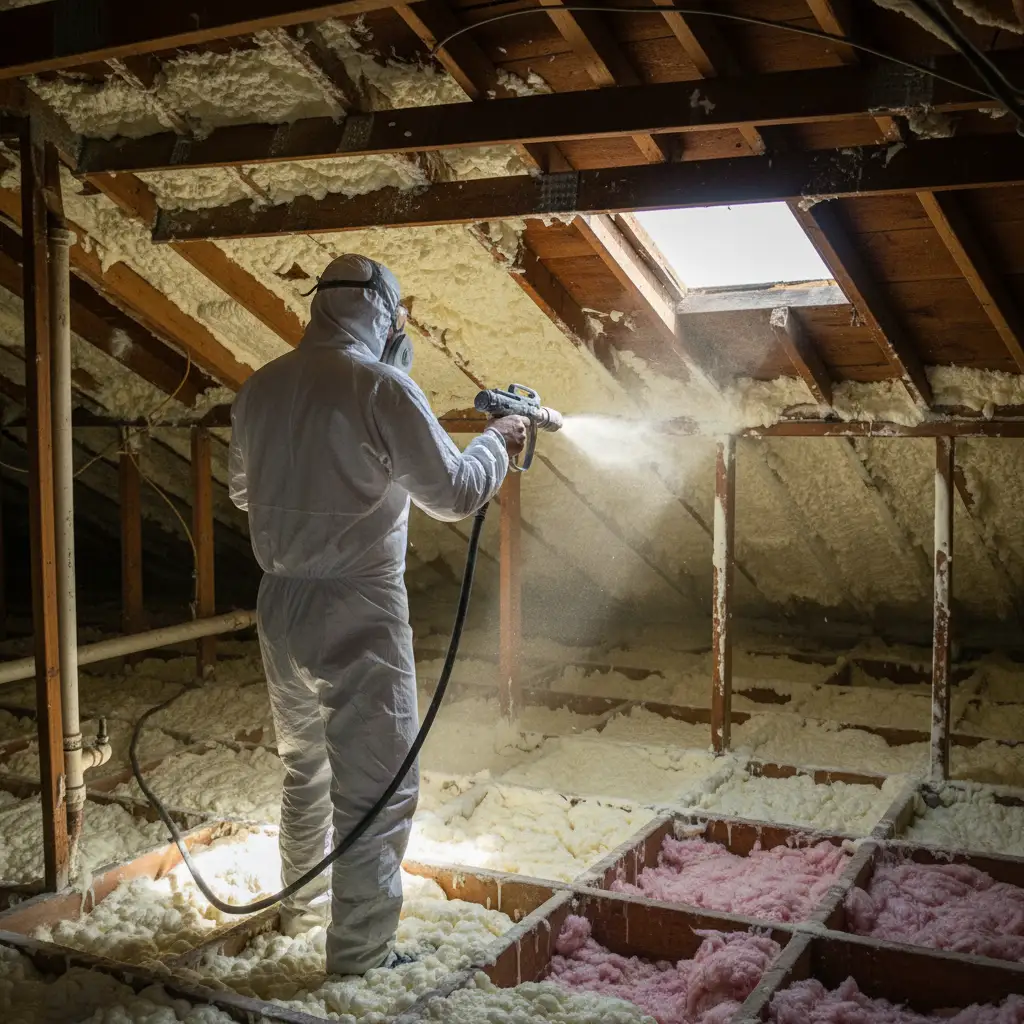
Our team in action — insulation professionals serving Los Angeles
Why Blown-In Insulation Is Needed in Los Angeles, CA
The Los Angeles Climate: More Extreme Than Most Residents Realize
Los Angeles spans multiple microclimates within a single metro area. The coastal communities of Malibu and Pacific Palisades experience average summer highs near 75°F, while the San Fernando Valley communities of Canoga Park, Reseda, and Chatsworth regularly record temperatures above 105°F during heat events. The California Building Standards Commission places inland Los Angeles in Climate Zone 9 and coastal communities in Climate Zone 8, each with distinct insulation requirements. Without adequate attic insulation, radiant heat gain from tile and composition roofs can raise attic temperatures to 150°F or higher on summer afternoons, forcing air conditioning systems to work 30–40% harder according to data from the California Energy Commission.
Santa Ana Wind Events and Air Infiltration
Los Angeles experiences Santa Ana wind events — hot, dry offshore winds originating in the Great Basin — primarily between October and March. Wind speeds during these events frequently exceed 50 mph in the Sepulveda Pass and the Cajon Pass corridor, and gusts above 80 mph have been recorded on the ridge lines of the Santa Monica Mountains. These events create significant pressure differentials across building envelopes, driving unconditioned air through gaps and penetrations in under-insulated attics. Blown-in insulation, particularly dense-pack cellulose at 3.5 lbs per cubic foot, dramatically reduces air infiltration compared to batt insulation, creating a more resilient barrier during these recurring wind episodes.
Wildfire Smoke Infiltration
The 2018 Woolsey Fire, which burned over 96,000 acres across Los Angeles and Ventura counties, and the 2025 Palisades Fire, which displaced tens of thousands of residents in Pacific Palisades and Altadena, demonstrated the devastating air quality impacts of wildfire events on interior living environments. Homes with poorly insulated and sealed attics experience dramatically higher rates of smoke infiltration during these events. Dense-pack blown-in insulation combined with proper air sealing can reduce particulate infiltration rates by a measurable degree, protecting indoor air quality during future wildfire emergencies.
Aging Housing Stock and Original Insulation Degradation
Neighborhoods like Leimert Park, Highland Park, and Boyle Heights contain significant concentrations of homes built between 1920 and 1950, many of which were originally insulated with vermiculite, mineral wool, or early fiberglass batts that have settled, compressed, or deteriorated over decades. Settled batt insulation loses R-value in direct proportion to its compression. A 6-inch fiberglass batt rated R-19 that has compressed to 4 inches may perform at R-13 or lower. Blown-in insulation is the ideal remedy because it can be added on top of existing degraded insulation without requiring removal, restoring attic assemblies to code-compliant performance levels.
Title 24 Energy Code Compliance
California’s Title 24 Building Energy Efficiency Standards are among the most stringent in the nation. Homeowners in Los Angeles who are undertaking permitted additions, ADU conversions, or HVAC replacements may be required to bring their insulation up to current standards as a condition of permit approval. Air Tight Insulation works alongside contractors and permit applicants to ensure blown-in insulation installations meet or exceed Title 24 requirements for Climate Zones 8 and 9.
Signs You Need Blown-In Insulation in Los Angeles
Energy and Comfort Indicators
- Monthly electricity bills exceeding $200–$300 during summer months despite moderate thermostat settings
- Rooms in the top floor of your home that are consistently 5°F or more warmer than ground-floor rooms
- Air conditioning or heating systems cycling on frequently and running for long periods without achieving set temperatures
- Cold drafts near ceiling fixtures or recessed lights during winter months
Visual and Physical Inspection Signs
- Attic insulation depth measuring less than 10 inches (approximately R-30 or below for fiberglass), which falls short of the Title 24 R-38 minimum for Climate Zone 9
- Visible gaps, bare spots, or compressed batts in the attic floor
- Insulation that appears dusty, discolored, or physically deteriorated
- Evidence of rodent activity — tunneling, nesting materials, or droppings — within existing insulation
Urgency Indicators
- Your home was built before 1980 and insulation has never been upgraded
- You have recently completed or are planning an ADU conversion in Los Angeles where a building permit will require Title 24 compliance
- You experienced significant smoke infiltration or air quality issues during a recent Santa Ana wind or wildfire event
- Your HVAC system is being replaced — this is the ideal time to maximize efficiency with upgraded insulation
Blown-In Insulation Methods and Approaches
Open-Blow Attic Application
The most common method for Los Angeles attic upgrades, open-blow installs loose-fill material across an open attic floor to a specified depth. This method is ideal for the vast majority of single-family homes in LA built after 1940, which feature accessible attic spaces with standard framing. Open-blow cellulose or fiberglass can be installed over existing insulation, making it a minimally invasive retrofit solution for homes throughout the San Fernando Valley and South Bay.
Dense-Pack Wall Insulation
For uninsulated or under-insulated wall cavities — common in pre-1950 homes in neighborhoods like Hancock Park, Windsor Hills, and Los Feliz — dense-pack cellulose is blown into wall cavities through small holes drilled in the exterior siding or interior drywall. Material is packed at 3.5 lbs per cubic foot to prevent settling and significantly reduce air infiltration. This method is particularly valued in Los Angeles’s older architectural districts where interior renovation would disturb historic plaster walls.
Stabilized or Spray-Applied Blown-In
For cathedral ceilings, sloped roof assemblies, or applications where the insulation surface must remain stable, blown-in batt (BIB) systems use a light mist of water or adhesive to help the material adhere to the installation surface. This approach is common in the split-level and hillside homes found throughout Silverlake, Eagle Rock, and the Hollywood Hills.
Combination Air Seal and Blown-In Systems
For maximum energy performance, we combine a thin layer of closed-cell spray foam at critical air leakage points — top plates, penetrations, and bypasses — followed by blown-in insulation to achieve the full target R-value. Learn more about our spray foam insulation services for details on this hybrid approach.
Ready for Blown-In Insulation? Get Your Free Estimate Today.
Air Tight Insulation serves Los Angeles and the surrounding area — we’ll be on-site within 24 hours.
📞 Call 323-618-6376Blown-In Insulation Cost in Los Angeles, CA
Understanding the cost of blown-in insulation in Los Angeles requires consideration of several local factors that influence pricing. Below are current market ranges for typical installations in the LA metro area.
Typical Price Ranges
- Attic blown-in insulation (open-blow, standard access): $1.50 to $2.50 per square foot of attic floor area. A typical 1,500 sq ft attic installation runs approximately $2,250 to $3,750.
- Dense-pack wall insulation: $3.00 to $5.00 per square foot of wall area, with drilling and patching included. A typical wall upgrade for a 1,200 sq ft home may range from $3,600 to $6,000.
- Combination air seal and blown-in upgrade: Add $0.50 to $1.00 per square foot over base blown-in pricing for comprehensive air sealing services.
Cost Factors Specific to Los Angeles
- Attic access difficulty: Many older Los Angeles homes have small attic hatches (14″ x 24″ is common in pre-1960 construction), requiring additional labor to maneuver equipment and materials.
- Existing insulation removal: If rodent-contaminated or moisture-damaged insulation requires removal first, add $1.00 to $2.00 per square foot for professional insulation removal services.
- Hillside home access: Properties on sloped lots in the Hollywood Hills, Laurel Canyon, or Topanga may involve additional labor for equipment staging and access.
- LADWP and SoCalGas rebates: Qualifying customers may receive rebates of $0.10 to $0.25 per square foot, reducing net installation costs meaningfully.
Call 323-618-6376 for a free, no-obligation quote specific to your Los Angeles property.
Neighborhoods We Serve in Los Angeles
San Fernando Valley (Reseda, Canoga Park, Van Nuys)
The Valley’s inland location places it firmly in Climate Zone 9, where summer temperatures routinely exceed 100°F. The area’s high concentration of post-war tract homes built between 1945 and 1965 — many with original fiberglass batt insulation at R-11 or less — represents the single largest opportunity for blown-in insulation upgrades in the Los Angeles metro area.
Silver Lake, Echo Park, and Los Feliz
These neighborhoods feature a mix of Craftsman bungalows, Spanish Colonial Revival homes, and hillside contemporaries built between 1910 and 1950. Many properties have uninsulated or minimally insulated wall cavities, making dense-pack blown-in wall insulation a frequently recommended solution.
South Bay (Torrance, Hawthorne, Inglewood)
Coastal Climate Zone 8 conditions moderate summer temperatures but introduce higher humidity levels that make moisture-resistant blown-in fiberglass the preferred material choice over cellulose in many applications.
East Los Angeles and Boyle Heights
This area’s stock of pre-1940 residential buildings, many with balloon-frame construction, presents unique dense-pack wall insulation opportunities and requires careful attention to fire blocking requirements during installation.
West Los Angeles and Culver City
A mix of mid-century modern and post-war construction with active ADU development activity, where Title 24 compliance for new permitted work regularly drives blown-in attic insulation upgrades.
Blown-In Insulation Maintenance Tips for Los Angeles Homeowners
- Inspect attic insulation depth annually. Use a ruler to verify that depth has not settled below the installed level. Some settling in the first year is normal for cellulose; fiberglass settles minimally.
- Check attic ventilation after major wind events. Santa Ana winds can displace lightweight insulation material near eave vents; verify that baffles remain in place after significant events.
- Seal any new penetrations promptly. HVAC duct work, new plumbing runs, or electrical upgrades can create air leakage pathways through the insulated attic floor — reseal these as work is completed.
- Control attic humidity. Los Angeles’s seasonal moisture swings can affect cellulose insulation performance if attic ventilation is inadequate. Ensure all soffit and ridge vents remain unobstructed.
- Inspect for rodent activity after summer and fall. Roof rats — common throughout Los Angeles — seek shelter as temperatures drop in October and November. Address any entry points in the roofline immediately to protect insulation integrity.
- Monitor energy bills as a performance indicator. A sudden increase in summer cooling costs without a rate change may indicate insulation settling, air leakage development, or HVAC duct issues in the attic.
- Schedule a professional reassessment every 10 years or after any significant roof repair, HVAC replacement, or suspected pest intrusion event.
Why Choose Air Tight Insulation for Blown-In Insulation in Los Angeles
Air Tight Insulation is a professional insulation contractor dedicated exclusively to serving the Los Angeles area. Unlike general contractors who offer insulation as a secondary service, our team focuses entirely on insulation systems — meaning our technicians develop deep expertise in the specific conditions, building types, and code requirements unique to the Los Angeles market.
We understand the difference between installing blown-in insulation in a 1920s Craftsman bungalow in Highland Park versus a 1960s ranch home in Chatsworth versus a contemporary hillside residence in the Hollywood Hills. Each situation demands different techniques, different materials, and knowledge of the local building environment that only comes from working in Los Angeles day after day.
Our team is familiar with LADWP and SoCalGas rebate programs and assists clients in maximizing available incentives. We coordinate with permit offices when required by Title 24 compliance projects and provide full documentation of installed R-values for permit and rebate purposes.
We offer the full range of related services under one roof, including attic insulation, crawl space insulation, rodent proofing, and attic cleaning, ensuring that your insulation investment is protected from the start.
Call us at 323-618-6376 to speak with a knowledgeable local insulation specialist today.
Frequently Asked Questions: Blown-In Insulation in Los Angeles
How much does blown-in insulation cost in Los Angeles?
Blown-in attic insulation in Los Angeles typically costs between $1.50 and $2.50 per square foot, meaning a standard 1,500 square foot attic installation runs approximately $2,250 to $3,750. Dense-pack wall insulation ranges from $3.00 to $5.00 per square foot. Factors that affect pricing include attic access difficulty, the need for existing insulation removal, and whether air sealing is included. LADWP and SoCalGas rebate programs can offset a portion of these costs for qualifying customers.
What R-value do I need for blown-in insulation in Los Angeles?
California’s Title 24 Energy Code requires a minimum of R-38 in attic assemblies for most of the Los Angeles metro area (Climate Zone 9). Coastal communities in Climate Zone 8 have slightly different requirements. To achieve R-38 with blown-in fiberglass, you need approximately 15 inches of installed depth; blown-in cellulose requires approximately 11–12 inches for the same R-value. During your free assessment, we will measure your existing insulation and recommend the additional depth needed to reach compliance.
How long does a blown-in insulation installation take?
For a typical single-family Los Angeles home with a 1,000 to 2,000 square foot attic, the complete installation — including air sealing preparation — generally takes four to eight hours. Larger attics, difficult access conditions common in older hillside homes, or projects requiring prior insulation removal will take longer. Most residential blown-in insulation projects in Los Angeles are completed in a single day.
Is blown-in insulation safe for older Los Angeles homes?
Yes. Modern blown-in cellulose and fiberglass insulation materials are non-toxic, fire-resistant, and safe for installation in homes of any age. Before installation, we inspect for any pre-existing conditions — such as knob-and-tube wiring, which is present in some pre-1940 homes in neighborhoods like West Adams and Leimert Park — that may need to be addressed by an electrician before insulation work proceeds. Our technicians are trained to identify these conditions during the initial assessment.
Will blown-in insulation help with wildfire smoke infiltration?
Blown-in insulation combined with comprehensive attic air sealing can meaningfully reduce the rate at which outdoor air — including smoke-laden air during wildfire events — infiltrates the living space through the ceiling assembly. While no insulation system creates a fully airtight barrier, dense-pack cellulose at proper density significantly reduces air exchange rates compared to batt insulation or no insulation. This is particularly relevant for homeowners in the western San Fernando Valley, Pacific Palisades corridor, and Foothill communities that face elevated wildfire exposure risk.
Can blown-in insulation be installed over my existing insulation?
In most cases, yes. If your existing insulation is in acceptable condition — not contaminated by rodents, mold, or moisture — blown-in insulation can be added directly on top to bring the total depth up to the target R-value. This is one of the primary advantages of blown-in insulation for Los Angeles retrofit projects: it avoids the cost and disruption of removing older materials. If existing insulation is damaged or contaminated, removal is recommended first.
Does Air Tight Insulation serve all areas of Los Angeles?
Yes. We serve the full Los Angeles metro area, including the San Fernando Valley, South Bay, Westside, East LA, the Hollywood Hills, and all communities within the City of Los Angeles and surrounding municipalities. Whether your property is in Chatsworth, Culver City, Boyle Heights, or Pacific Palisades, our team is equipped to handle your blown-in insulation project with the local knowledge your home deserves.
Are there rebates available for blown-in insulation in Los Angeles?
Yes. LADWP customers may qualify for insulation rebates under the Residential Energy Efficiency Program, and SoCalGas customers have access to similar incentive programs. Eligibility requirements and rebate amounts are subject to change; we stay current on available programs and assist our clients with rebate applications as part of our standard service process.
Get a Free Blown-In Insulation Estimate in Los Angeles Today
Whether your Los Angeles home is a 1920s Craftsman in Highland Park, a mid-century ranch in the Valley, or a contemporary hillside residence in Los Feliz, Air Tight Insulation has the local expertise to evaluate your current insulation conditions, recommend the right solution, and deliver a professional installation that meets California’s Title 24 standards.
Do not let another brutal Los Angeles summer drive up your electricity bills or another Santa Ana wind event send cold air pouring through your ceiling. The investment in properly installed blown-in insulation pays for itself in energy savings, improved comfort, and better indoor air quality.
Call Air Tight Insulation today at 323-618-6376 to schedule your free in-home assessment. Our team serves all Los Angeles neighborhoods and is ready to provide a transparent, itemized estimate with no obligation. You can also explore our related services including attic insulation, spray foam insulation, and rodent proofing to protect your home completely.