
Insulation Installation in Los Angeles, CA
Expert Insulation Installation in Los Angeles, CA for Los Angeles, CA Homes & Businesses
Air Tight Insulation offers expert insulation installation in Los Angeles, CA. Attic, spray foam, blown-in & more. Call 323-618-6376 for a free estimate today.
- Licensed & Insured
- Locally Owned & Operated
- Free Inspection & Estimate
Request Your
Free EstimateInsulation installation is the process of applying thermal and acoustic barrier materials within walls, attics, crawl spaces, and floors to regulate indoor temperatures, reduce energy consumption, and improve comfort. In Los Angeles, where temperatures can swing from the mid-40s°F on winter nights in the San Fernando Valley to over 100°F during summer heat waves in areas like the Inland-adjacent communities of East LA, proper insulation is not a luxury — it is a necessity.
At Air Tight Insulation, we specialize in professional insulation installation tailored to the unique climate, building stock, and energy codes of Los Angeles, CA. Whether you own a 1920s Craftsman bungalow in Highland Park, a mid-century modern in Silver Lake, or a newer construction in Playa Vista, our team brings the expertise, equipment, and local knowledge needed to deliver a high-performance insulation solution. Call us today at 323-618-6376 to schedule your free assessment.
Understanding Insulation Installation in Los Angeles, CA
Insulation works by slowing the transfer of heat between the interior of a building and the outside environment. Materials with high R-values — a measure of thermal resistance — are more effective at blocking this heat transfer. The higher the R-value per inch of material, the better the insulation performance. California’s Title 24 Building Energy Efficiency Standards, last significantly updated in 2022, now require climate-zone-specific R-values that are notably more demanding than in previous decades.
Los Angeles falls primarily within California Climate Zone 9 (central Los Angeles basin) and Climate Zone 10 (portions of the San Gabriel Valley and foothill communities), both of which carry specific R-value requirements. For attics in these zones, Title 24 mandates a minimum of R-38, while walls typically require R-13 to R-21 depending on framing type. Many older Los Angeles homes — built before the California Energy Code was first adopted in 1978 — contain little to no insulation at all, or feature degraded materials such as compressed fiberglass batts or vermiculite (which can contain asbestos in pre-1980 installations).
The city’s housing stock reflects more than a century of construction waves. The post-World War I bungalow boom brought thousands of wood-frame homes to neighborhoods like Boyle Heights and Echo Park. The post-World War II suburban expansion added stucco-clad tract homes across the San Fernando Valley. Each era presents distinct insulation challenges: older balloon-frame walls with open cavities, minimal attic depth in ranch-style homes, and uninsulated concrete slab foundations common in 1950s and 1960s construction.
Modern insulation installation in Los Angeles is also shaped by wildfire risk, air quality considerations (SCAQMD regulations limit certain spray foam blowing agents), and the growing adoption of all-electric homes under California’s evolving building codes. Understanding these layers — historical, regulatory, and environmental — is what separates a knowledgeable local contractor from a generalist. At Air Tight Insulation, we navigate all of these factors for every project we undertake.
Why Insulation Installation Is Needed in Los Angeles
Extreme Heat Events
The September 2022 heat wave broke all-time records across the region, with Woodland Hills — part of the City of Los Angeles — hitting 116°F on September 6, 2022, shattering the previous record. During that event, poorly insulated homes in the San Fernando Valley saw indoor temperatures exceed 95°F even with air conditioning running continuously. Proper attic insulation with a minimum R-49 in these higher-heat inland neighborhoods can reduce cooling loads by 20–30%, according to ENERGY STAR estimates.
The Urban Heat Island Effect
Dense, paved neighborhoods like Downtown Los Angeles, Koreatown, and Boyle Heights experience urban heat island effects of 5–8°F above surrounding suburban areas, measured consistently in studies by the USC Urban Climate Lab. This means a home in Koreatown that appears to be in a “mild” climate is functionally experiencing higher sustained temperatures than a comparably located home elsewhere, driving up cooling demand and accelerating the degradation of poorly installed insulation materials.
Marine Layer and Moisture Intrusion
Coastal neighborhoods such as Venice, Mar Vista, and the communities along the Santa Monica Bay corridor experience persistent marine layer conditions — dense coastal fog — especially from May through August, a period locals call “June Gloom.” This moisture can infiltrate under-ventilated attic spaces and condense within degraded or improperly vapor-managed insulation, reducing effective R-values and promoting mold growth in wood framing. Replacing or upgrading insulation with moisture-resistant materials is especially critical within 2 miles of the coastline.
Wildfire Ember Intrusion
Following the January 2025 Palisades Fire, which destroyed more than 6,800 structures across Pacific Palisades and Altadena, building scientists identified ember intrusion through attic vents as a primary ignition pathway. Upgrading to fire-resistant insulation — particularly mineral wool batts with a Class A fire rating — while simultaneously air-sealing attic penetrations is now strongly recommended for homes in Fire Hazard Severity Zones (FHSZ), which cover large portions of the Santa Monica Mountains, the Hollywood Hills, and the Verdugo Mountains within LA city limits.
Aging Housing Stock
Approximately 40% of Los Angeles’s single-family residential buildings were constructed before 1960, according to LA County Assessor data. The vast majority of these homes were built with no wall insulation and minimal attic insulation — or none at all. As these homes change ownership or undergo renovation, insulation upgrades become both a comfort improvement and a code compliance requirement.
Signs You Need Insulation Installation in Los Angeles
Energy and Comfort Indicators
- Monthly electricity bills exceeding $200–$250 during summer months despite moderate air conditioning use
- Rooms that feel noticeably hotter or cooler than the thermostat setting, particularly upper-floor bedrooms under the attic
- HVAC system running continuously during peak afternoon hours (2 PM–6 PM) in summer
- Cold floors during winter mornings in homes with a crawl space or uninsulated slab
Physical Warning Signs
- Visible gaps, compression, or moisture staining on attic insulation observed during a visual inspection
- Insulation material that appears gray-black (indicating airflow and particulate accumulation through degraded batts)
- Rodent droppings, nesting material, or urine staining in attic or crawl space insulation — common in older hillside homes in Glassell Park and Mount Washington
- Peeling paint or condensation on interior walls, which can indicate thermal bridging through uninsulated stud cavities
Urgency Indicators
- Home was built before 1978 and insulation has never been replaced (possible asbestos or degraded fiberglass)
- Recent rodent infestation confirmed — insulation must be removed, sanitized, and replaced
- Home is located in a FHSZ zone and existing insulation is non-fire-rated
Our Insulation Installation Process
Air Tight Insulation follows a structured, multi-step process designed to ensure thorough, code-compliant, and lasting results for Los Angeles homeowners.
Free In-Home Assessment (1–2 Hours)
Our technician visits your property, inspects existing insulation in the attic, walls, and crawl space, identifies air leaks, assesses ventilation, and documents current R-values. We note any California Climate Zone-specific requirements and flag any potential hazardous materials such as vermiculite or damaged fiberglass.
Hazardous Material Testing and Removal (If Required, 1–3 Days)
For homes built before 1980, we test suspect materials for asbestos in accordance with SCAQMD Rule 1403 before any disturbance. If removal is required, it is performed by our licensed team under proper containment protocols. Learn more about our Insulation Removal services
Attic and Crawl Space Preparation (Half Day)
We seal all air penetrations — electrical boxes, pipe chases, HVAC ducts — with fire-rated caulk and foam before installing new insulation. This air-sealing step is critical in older LA homes where attic bypasses can account for 30–40% of total heat loss.
Insulation Installation (1–2 Days Depending on Scope)
We install the selected insulation product — blown-in cellulose, fiberglass batts, spray foam, or a hybrid system — to meet or exceed Title 24 R-value requirements for your specific climate zone. All work is performed in compliance with California Building Code Chapter 13 and local LA Department of Building and Safety (LADBS) requirements.
Ventilation Verification (1–2 Hours)
We verify that attic ventilation meets the 1:150 net free area ratio (or 1:300 with balanced ridge-and-soffit venting) required by the California Residential Code, ensuring that new insulation does not block soffit vents — a common installation error in older LA attics.
Final Inspection and Documentation (1 Hour)
We provide a written summary of installed R-values, materials used, and any permit documentation required by LADBS. This record is valuable for future home sales, insurance adjustments, and utility rebate applications through programs like SoCalGas and LADWP’s residential energy efficiency incentives.
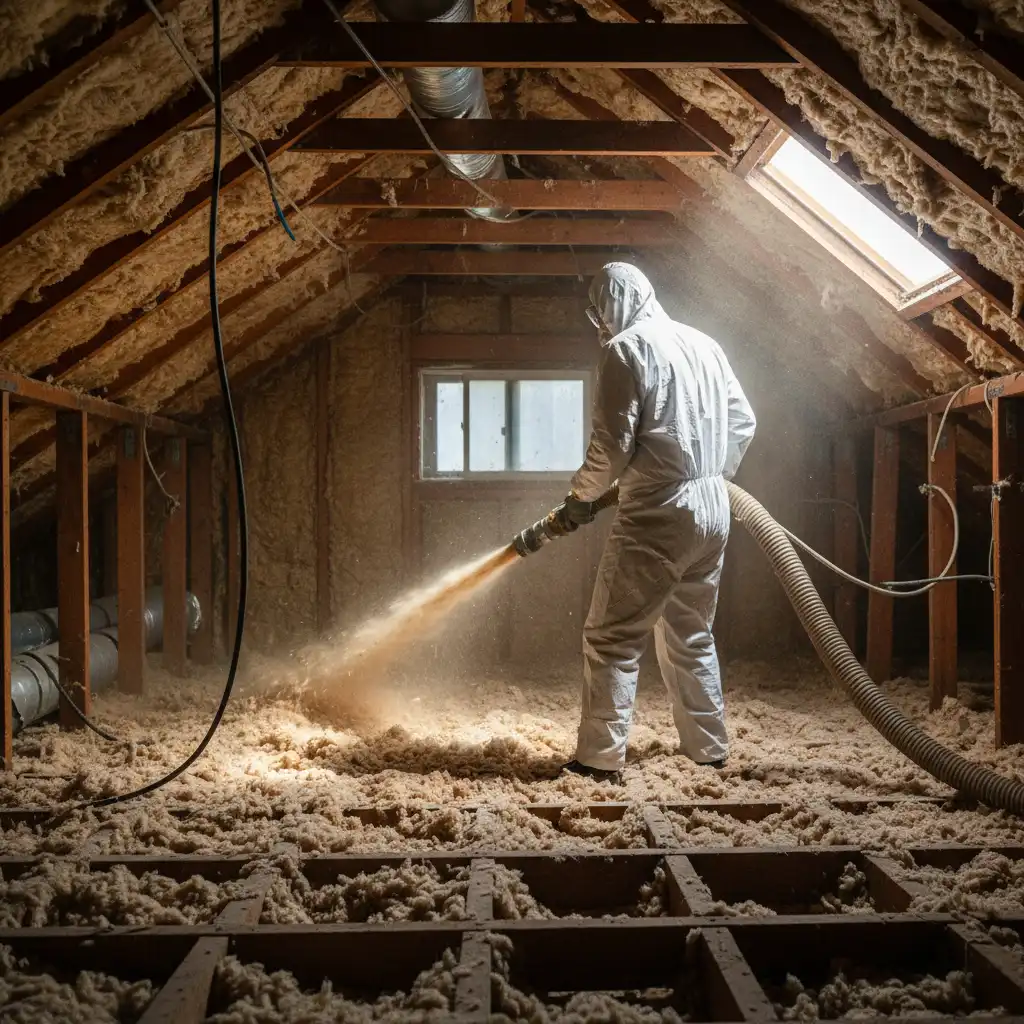
Our team in action — insulation professionals serving Los Angeles
Insulation Methods and Approaches We Use
Blown-In Insulation
Ideal for retrofitting existing attics without disturbing living spaces. Blown-in cellulose (made from recycled newsprint) achieves R-2.5 to R-3.7 per inch and settles evenly over existing framing. It is particularly well-suited for the irregular attic geometries found in pre-war Craftsman homes in neighborhoods like Angelino Heights. Explore our Blown-In Insulation services
Spray Foam Insulation
Open-cell spray foam (R-3.7/inch) and closed-cell spray foam (R-6.5/inch) provide both thermal resistance and air sealing in a single application. Closed-cell foam is especially effective for the underside of roof decks in hillside homes in Laurel Canyon and Beachwood Canyon, where cathedral ceilings and limited attic access make batt installation impractical. Explore our Spray Foam Insulation services
Fiberglass Batt Insulation
Pre-cut fiberglass batts remain a cost-effective solution for new construction and open-wall renovation projects. Available in R-13, R-15, R-19, and R-21 configurations, batts are commonly installed in wall cavities during kitchen and bathroom remodels across mid-century homes in Culver City-adjacent and Palms neighborhoods. Explore our Fiberglass Insulation services
Crawl Space Insulation
Los Angeles homes built on raised foundations — common in hillside communities and older flatland neighborhoods — benefit from R-19 to R-25 fiberglass batts or closed-cell spray foam applied to floor joists. This reduces cold-floor complaints in winter and controls moisture intrusion from ground-level soil. Explore our Crawl Space Insulation services
Attic Insulation
Our most-requested service in Los Angeles, attic insulation upgrades address the single largest source of thermal gain and loss in most single-family homes. Explore our Attic Insulation services
Ready for Insulation Installation? Get Your Free Estimate Today.
Air Tight Insulation serves Los Angeles and the surrounding area — we’ll be on-site within 24 hours.
📞 Call 323-618-6376Insulation Installation Cost in Los Angeles, CA
Understanding insulation installation costs in Los Angeles requires accounting for several local factors including labor rates, material availability, home age, and access complexity.
Typical Price Ranges
- Attic Blown-In Insulation: $1.50–$3.00 per square foot installed. For a typical 1,200 sq ft attic in a San Fernando Valley ranch home, expect $1,800–$3,600.
- Spray Foam Insulation (Open-Cell): $1.00–$1.50 per board foot. A 1,500 sq ft attic spray-foamed to 5 inches costs approximately $7,500–$11,250.
- Spray Foam Insulation (Closed-Cell): $2.00–$3.50 per board foot, reflecting higher material cost.
- Fiberglass Batt Installation (Walls): $0.50–$1.00 per square foot of wall area for open-wall applications.
- Crawl Space Insulation: $2.00–$5.00 per square foot depending on access difficulty and moisture remediation needs.
Los Angeles-Specific Cost Factors
Labor costs in Los Angeles are 15–25% higher than the national average, reflecting prevailing wages in the LA metro area. Hillside homes in neighborhoods like Silver Lake, Eagle Rock, and the Hollywood Hills often incur access surcharges of $300–$800 due to limited equipment staging areas and steep lot grades. Homes requiring prior insulation removal add $1.00–$2.50 per square foot to the total project cost.
Available Rebates
LADWP offers rebates of up to $0.10 per square foot for qualifying attic insulation upgrades. SoCalGas provides rebates through the Energy Upgrade California program. These incentives can reduce net project costs by $150–$600 depending on scope.
Call 323-618-6376 for a detailed written estimate specific to your home.
Insulation Installation Neighborhoods We Serve in Los Angeles
Silver Lake and Echo Park
Dominated by 1910s–1940s wood-frame bungalows and hillside homes, these neighborhoods frequently feature zero wall insulation and compressed or absent attic insulation. Hillside lot constraints require specialized equipment staging. Insulation Installation in Silver Lake
San Fernando Valley (Northridge, Canoga Park, Van Nuys)
Post-war tract homes built between 1945 and 1970 make up the majority of housing here. These homes are susceptible to extreme summer heat (Northridge reached 111°F in July 2021) and benefit significantly from R-49 attic upgrades and wall cavity insulation added during remodels.
Koreatown and Mid-Wilshire
A mix of 1920s apartment buildings and 1960s–1980s multi-family construction. Urban heat island effects are pronounced here, and many buildings have never received insulation upgrades. We serve both residential and smaller multi-family buildings in this corridor.
Pacific Palisades and Brentwood
Larger, higher-value homes in Fire Hazard Severity Zones. Post-Palisades Fire (January 2025) rebuilds and retrofits increasingly specify fire-rated mineral wool insulation and comprehensive air-sealing packages.
Boyle Heights and East Los Angeles
One of LA’s oldest residential communities, with substantial housing stock from the 1910s–1930s. Balloon-frame construction with open wall cavities and original wood-lathe plaster walls presents unique retrofit challenges we have extensive experience addressing.
Insulation Maintenance Tips for Los Angeles Homeowners
- Inspect attic insulation every 3–5 years for compression, moisture staining, or pest activity. LA’s dry climate can lull homeowners into skipping inspections, but marine layer moisture and rodent pressure make regular checks essential.
- Check attic vents annually before the summer heat season (April is ideal) to ensure soffit and ridge vents are unobstructed. Debris from Santa Ana wind events can block vents and trap heat.
- Monitor for rodent activity particularly in hillside and foothill neighborhoods adjacent to open space. Roof rats and squirrels commonly nest in attic insulation, contaminating it and reducing its R-value.
- After any significant rain event (LA receives approximately 14 inches of rain annually, often in concentrated storms), inspect the attic for signs of roof leaks that may have saturated insulation.
- Ensure HVAC ducts in the attic are sealed. Leaky ducts in an insulated attic can redistribute conditioned air into unconditioned space, reducing system efficiency by 20–30%.
- Consider a radiant barrier in combination with blown-in insulation for San Fernando Valley homes. Radiant barriers reduce radiant heat gain through roofs by up to 25% in LA’s high-solar-radiation environment.
- Document your insulation R-values for LADWP/SoCalGas rebate applications and future resale disclosure requirements under California Civil Code Section 1102.
Why Choose Air Tight Insulation in Los Angeles?
At Air Tight Insulation, we are a professional insulation contractor deeply rooted in the Los Angeles community. We understand that no two LA homes are the same — a 1920s Craftsman in Highland Park, a 1960s ranch in Reseda, and a new-build in Playa Vista each demand a different approach, different materials, and a different level of expertise.
Our technicians are trained on California Title 24 compliance, LADBS permit processes, and the specific challenges posed by LA’s microclimates, aging housing stock, and Fire Hazard Severity Zones. We use only high-quality, California-compliant materials — including SCAQMD-compliant spray foam formulations and fire-rated mineral wool options for FHSZ properties.
We serve all of Los Angeles, from the coastal communities of Venice and Pacific Palisades to the inland heat of the San Fernando Valley and the historic neighborhoods of East LA and Boyle Heights. We provide transparent, itemized written estimates, clear timelines, and communicate with you at every stage of the project.
Ready to get started? Call us at 323-618-6376 or visit our full list of services below.
View All Insulation Services | Attic Cleaning Services | Rodent Proofing Services
Frequently Asked Questions: Insulation Installation in Los Angeles, CA
How much does insulation installation cost in Los Angeles?
Costs vary based on the type of insulation, the size of the area, and site-specific conditions. In Los Angeles, attic blown-in insulation typically ranges from $1,800 to $3,600 for an average home. Spray foam projects run $7,500–$15,000 for full attic coverage. Wall insulation during a remodel adds $0.50–$1.00 per square foot of wall area. Hillside homes and those requiring prior insulation removal will have higher total costs. Call 323-618-6376 for a free itemized estimate.
How long does insulation installation take in Los Angeles?
A standard attic blown-in insulation project on a 1,200–1,500 sq ft Los Angeles home is typically completed in one day. Larger projects, crawl space installations, or homes requiring prior insulation removal and hazardous material abatement may take 2–4 days. We provide a project timeline during your initial assessment.
Do I need a permit for insulation installation in Los Angeles?
In most cases, straightforward insulation replacements and upgrades in existing homes do not require a building permit from the LA Department of Building and Safety (LADBS). However, certain scope combinations — particularly those involving spray foam on the underside of roof decks or changes to attic ventilation — may require a permit. We assess permit requirements for every project and handle the application process on your behalf when needed.
Is there insulation installation near me in the San Fernando Valley?
Yes. Air Tight Insulation serves all San Fernando Valley communities including Northridge, Canoga Park, Van Nuys, Sherman Oaks, Encino, Reseda, Chatsworth, and Granada Hills. The Valley’s extreme summer temperatures — regularly exceeding 100°F — make it one of our highest-demand service areas. Insulation Installation in the San Fernando Valley
What R-value do I need for my Los Angeles home?
Los Angeles falls within California Climate Zones 9 and 10. Title 24 requires a minimum of R-38 for attic insulation, though we typically recommend R-49 for homes in hotter inland communities such as those in the eastern San Fernando Valley and the Foothill communities. Wall insulation requirements range from R-13 to R-21. We verify your specific climate zone during the initial assessment.
Does insulation help with the Los Angeles heat waves?
Significantly. During events like the record-breaking September 2022 heat wave, when Woodland Hills hit 116°F, homes with properly installed R-49 attic insulation and air-sealed envelopes maintained indoor temperatures 15–25°F lower than comparable uninsulated homes, even with reduced air conditioning use. Insulation is one of the highest-ROI upgrades available to LA homeowners for heat resilience.
Do you offer insulation removal before installing new insulation?
Yes. We provide full insulation removal services, including handling of potentially hazardous older materials, rodent-contaminated insulation, and moisture-damaged batts. Removal is followed by attic cleaning and sanitizing before new insulation is installed. Learn about our Insulation Removal process
Are there rebates available for insulation installation in Los Angeles?
Yes. LADWP offers residential insulation rebates of approximately $0.10 per square foot for qualifying upgrades. SoCalGas customers may access additional rebates through the Energy Upgrade California program. We help identify and document all applicable rebates as part of our project wrap-up process, potentially saving you $150–$600 depending on your project scope.
Get Your Free Insulation Installation Estimate in Los Angeles Today
Don’t let another brutal San Fernando Valley summer or chilly coastal night cost you more than it should. Air Tight Insulation is ready to assess your Los Angeles home, identify the right insulation solution for your climate zone and building type, and deliver a professional installation that meets California Title 24 standards and stands up to LA’s demanding conditions.
Whether you’re in Silver Lake, Northridge, Koreatown, or the Pacific Palisades — we’re your local insulation experts.
Call us now at 323-618-6376 to schedule your free, no-obligation in-home assessment. You can also explore our full range of services including Attic Insulation, Spray Foam Insulation, Rodent Proofing, and Attic Cleaning. We look forward to making your Los Angeles home more comfortable, efficient, and protected — starting today.